Skip to content

Open source · AGPL-3.0 · Python

Geotechnical engineering,one family of tools.

SlipSurface IQ is a family of ten geotechnical engineering programs for slopes, rock, foundations and retaining structures. They share one architecture: driven from your browser, bilingual in English and Turkish, reporting to PDF, HTML and Word, and tested against closed-form solutions.

$ pip install git+https://github.com/hdaltuntas/slipsurface
$ slipsurface
SlipSurface IQ 0.3.1 — http://127.0.0.1:8770/

$ slipsurface bearing run project.bearing
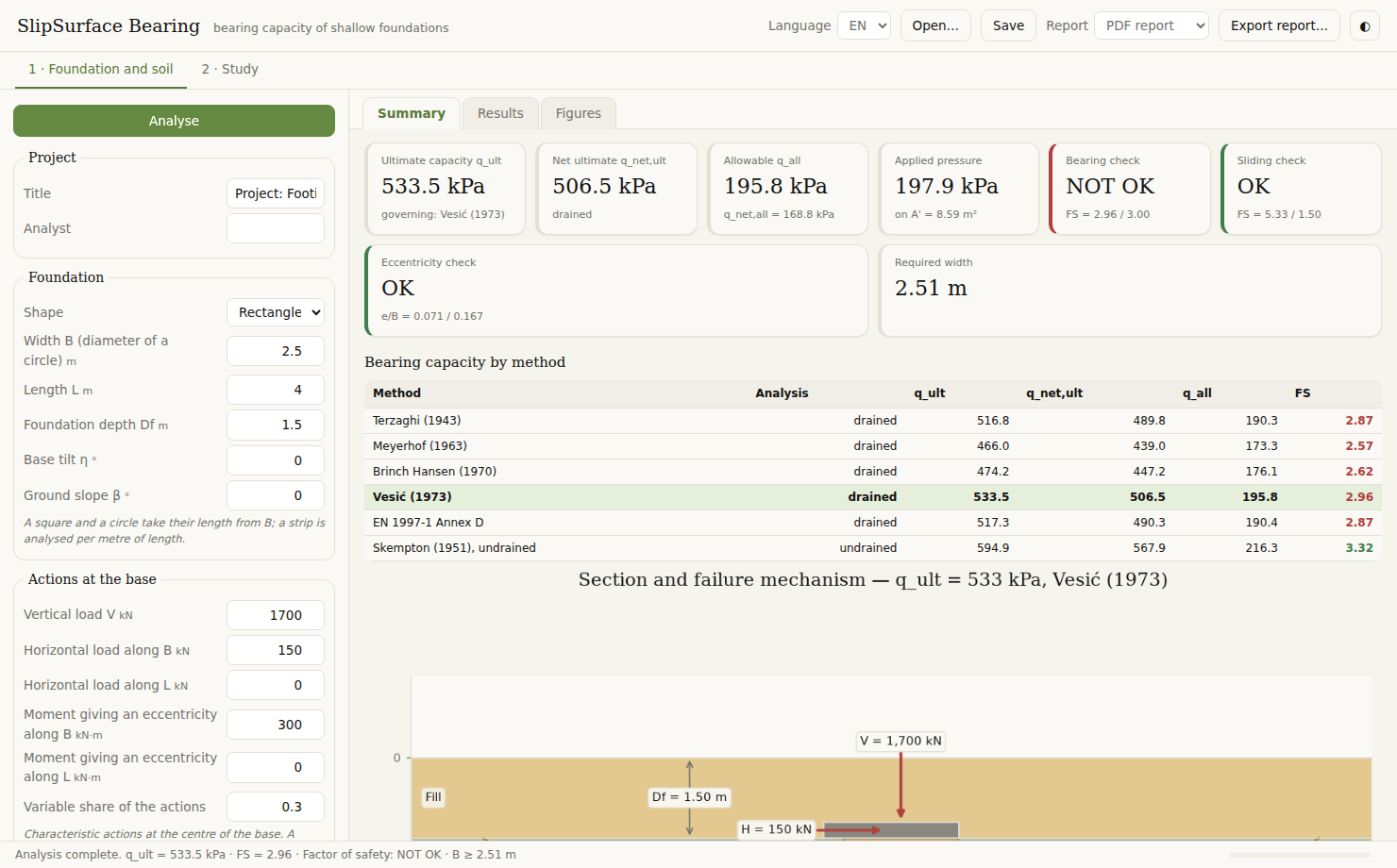
Bearing capacity by method
  Terzaghi (1943)        q_ult = 516.8 kPa
  Meyerhof (1963)        q_ult = 466.0 kPa
  Brinch Hansen (1970)   q_ult = 474.2 kPa
  Vesić (1973) *         q_ult = 533.5 kPa
  EN 1997-1 Annex D      q_ult = 517.3 kPa
  Sliding: FS = 5.33 ≥ 1.50 — OK

Opens in your browser; your data never leaves your machine.

KinematicRockLE2DBearingSettlePileSPWAMSEWWall
Every structure in this section is analysed by one of the SlipSurface IQ tools — point at one.
10programs
2languages — English and Turkish
3interfaces — browser, CLI, Python
3report formats — PDF, HTML, Word

The family

Each tool does one job in depth; together they cover the geotechnical design of a whole project.

Slopes

Finite elements and limit equilibrium.

SlipSurface IQ 2Dv0.3.1

2D finite element analysis

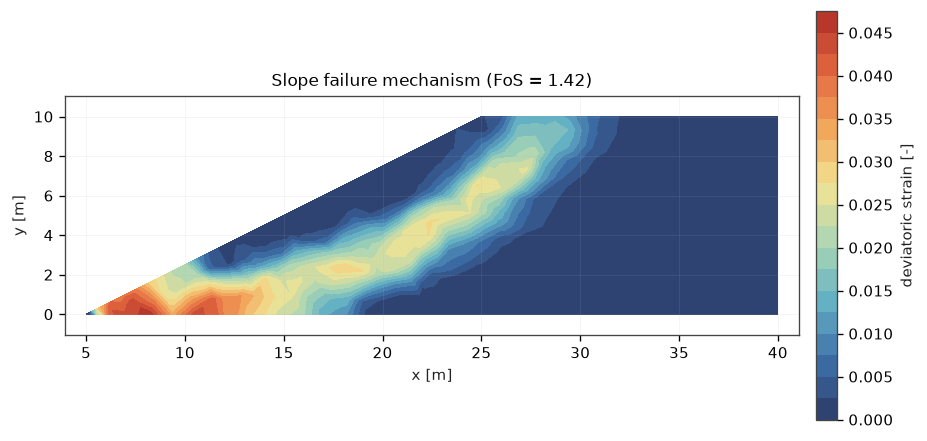
2D finite elements for slopes, embankments and deep excavations: factor of safety by strength reduction, staged construction, internal forces in walls and piles, sections and construction sequence straight from DXF.

  • Strength reduction (SSR)
  • Staged construction
  • DXF import
  • Wall and anchor forces
$ slipsurface-2d

SlipSurface IQ LEv0.3.1

Limit equilibrium slope stability

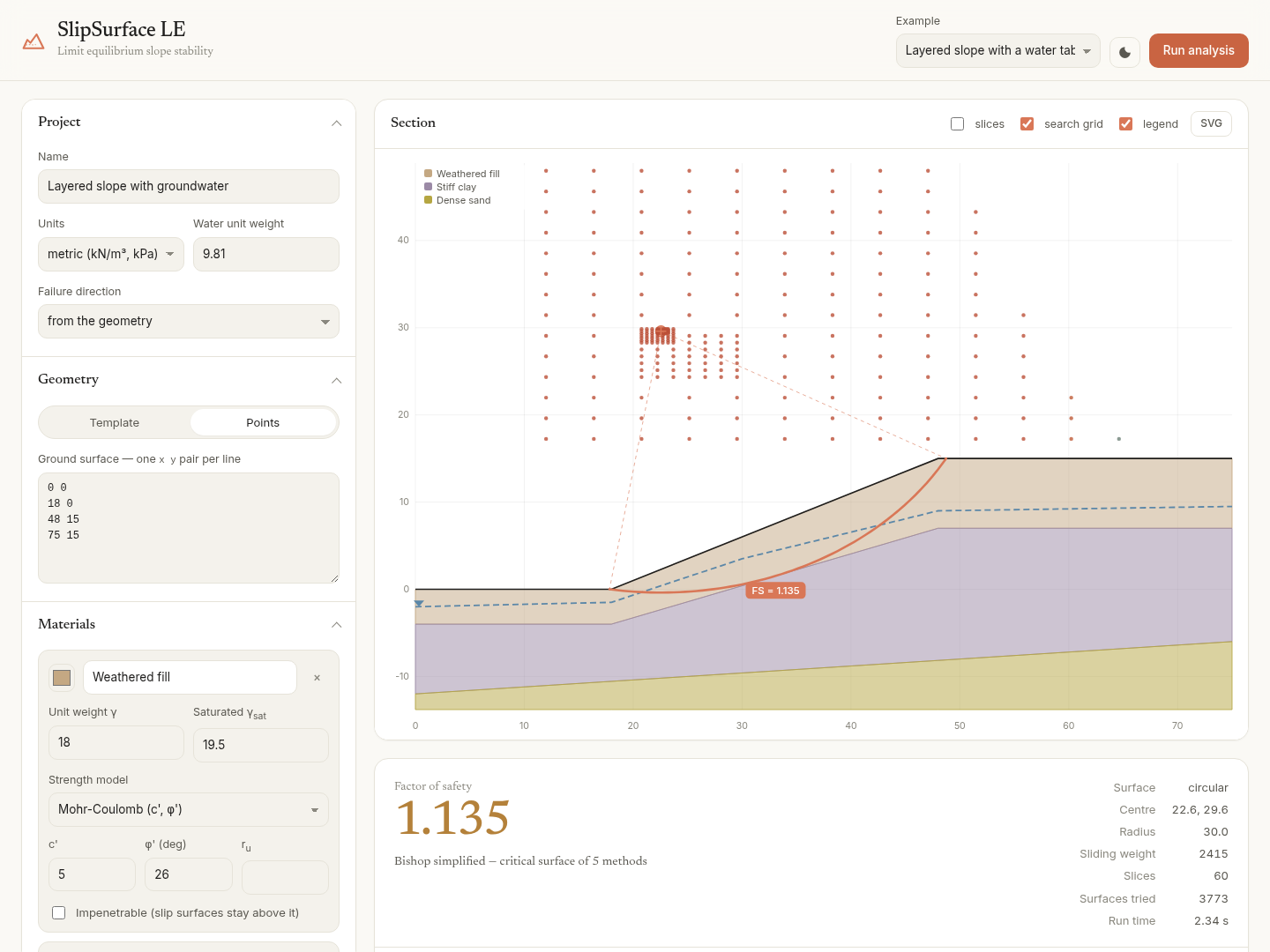
Method-of-slices stability of slopes and embankments: eight methods from Fellenius to Morgenstern-Price, critical surface search, water, seismic, reinforcement and tension cracks — with zero dependencies.

  • 8 limit equilibrium methods
  • Circular and non-circular
  • No dependencies
  • Validated against ACADS
$ slipsurface-le

Rock engineering

Rock mass strength and rock slope kinematics.

SlipSurface IQ Kinematicv0.3.1

Rock slope kinematics and stability

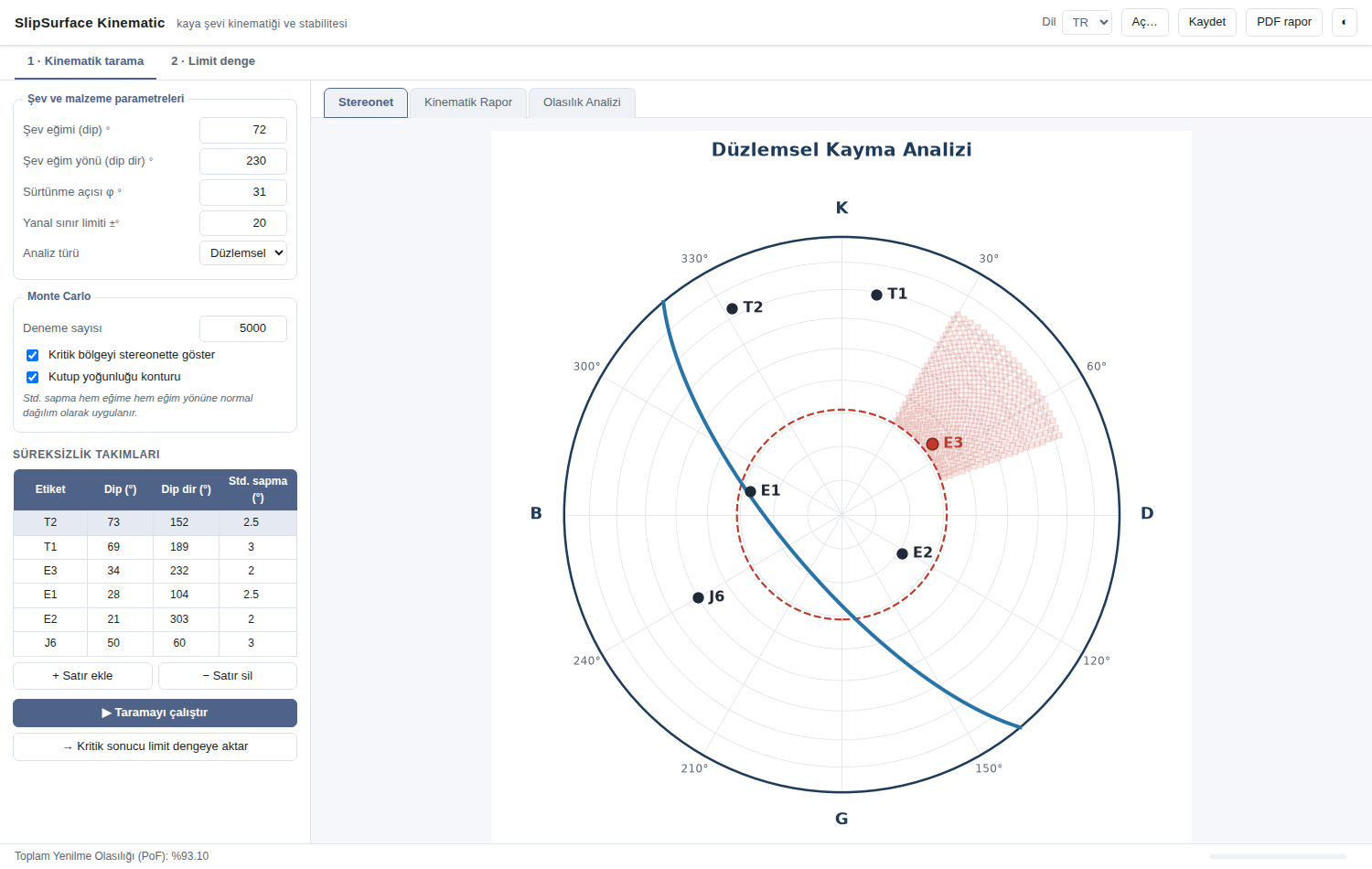
Markland screening on a stereonet and Monte Carlo probability of failure, then wedge, planar and toppling limit equilibrium, bolt design and PDF reports — in one workflow.

  • Markland test + stereonet
  • Monte Carlo probability
  • Wedge · planar · toppling
  • Bolt spacing × length matrix
$ slipsurface-kinematic

SlipSurface IQ Rockv0.3.1

Rock mass strength after Hoek–Brown

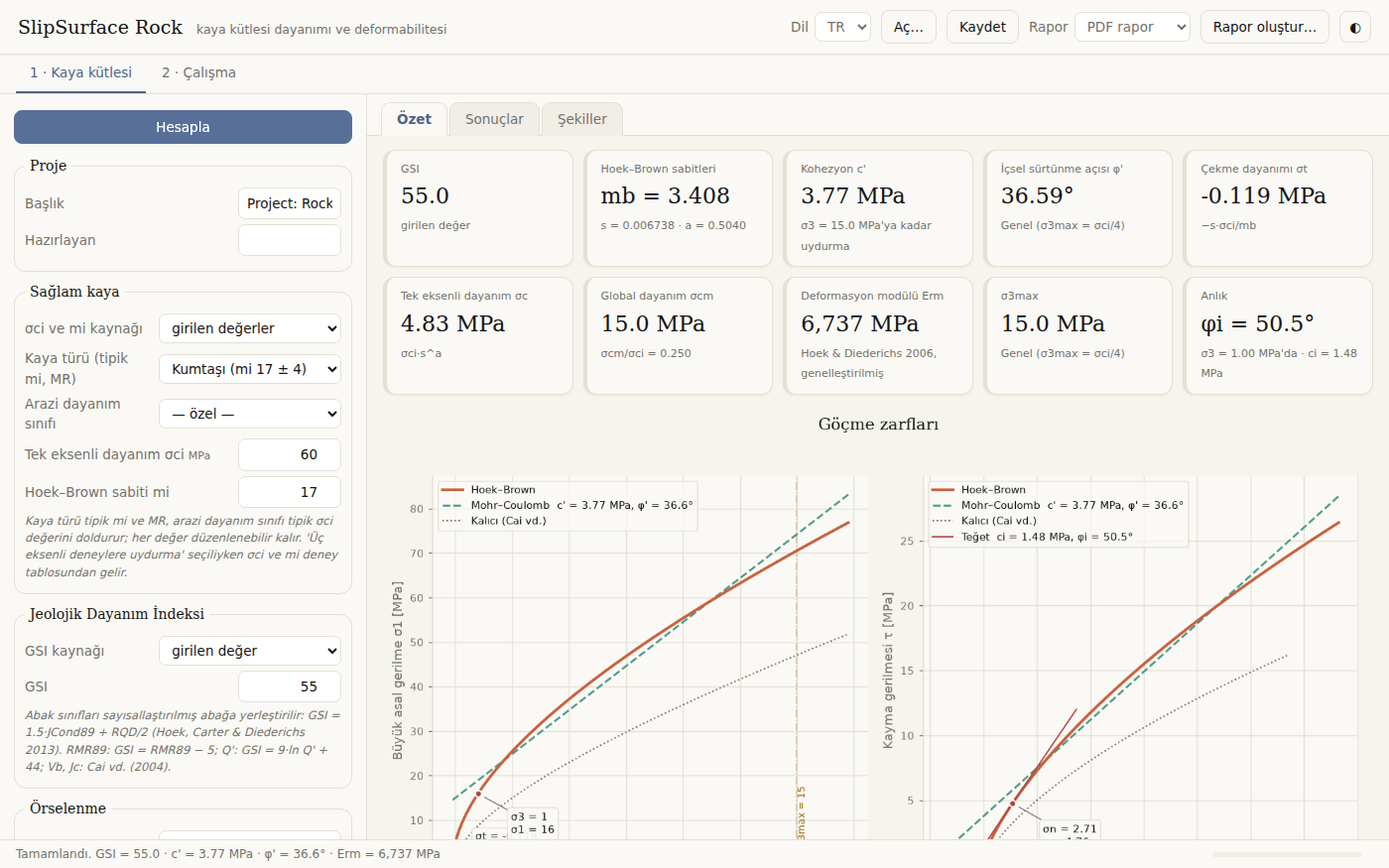
mb, s and a by the generalised Hoek–Brown criterion; the equivalent c′ and φ′ of a tunnel, a slope or a general case; the rock mass modulus; GSI from five classifications; σci and mi fitted to triaxial tests; residual strength.

  • Generalised Hoek–Brown
  • Tunnel · slope · general c′, φ′
  • GSI five ways
  • Triaxial test fitting
$ slipsurface-rock

Foundations

Shallow foundation capacity, settlement and piles.

SlipSurface IQ Bearingv0.3.1

Bearing capacity of shallow foundations

Terzaghi, Meyerhof, Hansen, Vesić, EN 1997-1 and Skempton side by side; eccentric and inclined loads, layered ground, SPT/CPT/pressuremeter, rock, earthquake and reliability studies.

  • 6 factor sets side by side
  • EN 1997-1 DA1/DA2/DA3
  • Punching and load spread
  • Probability of failure and β
$ slipsurface-bearing

SlipSurface IQ Settlev0.3.1

Settlement of foundations and embankments

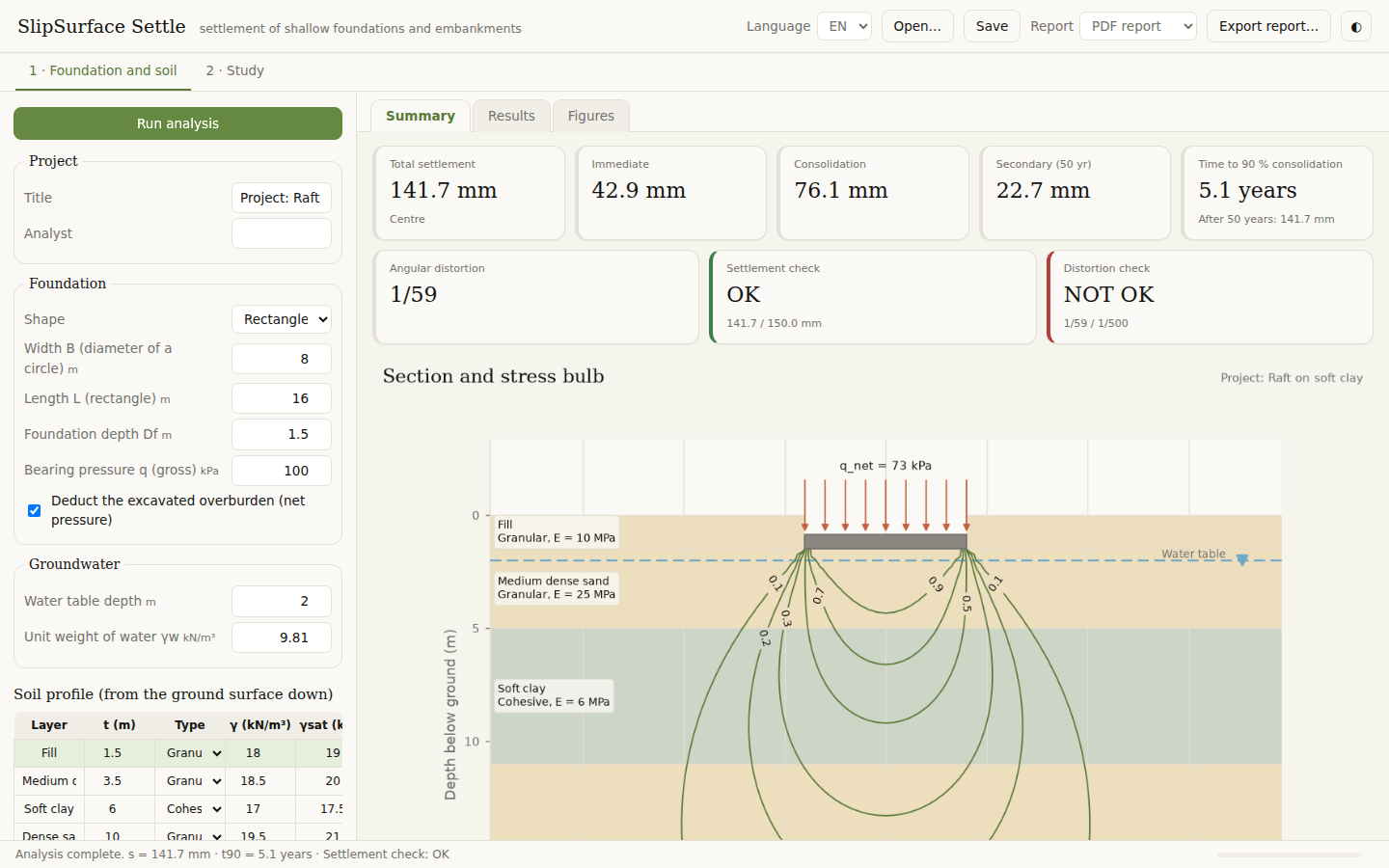
Boussinesq and 2:1 stress distribution, Steinbrenner and Schmertmann immediate settlement, primary consolidation and secondary compression, Terzaghi time–settlement and angular distortion checks.

  • Immediate + consolidation + secondary
  • Embankment (trapezoidal) loads
  • t50, t90 and time curve
  • Probability of exceedance
$ slipsurface-settle

SlipSurface IQ Pilev0.3.1

Pile capacity, groups and settlement

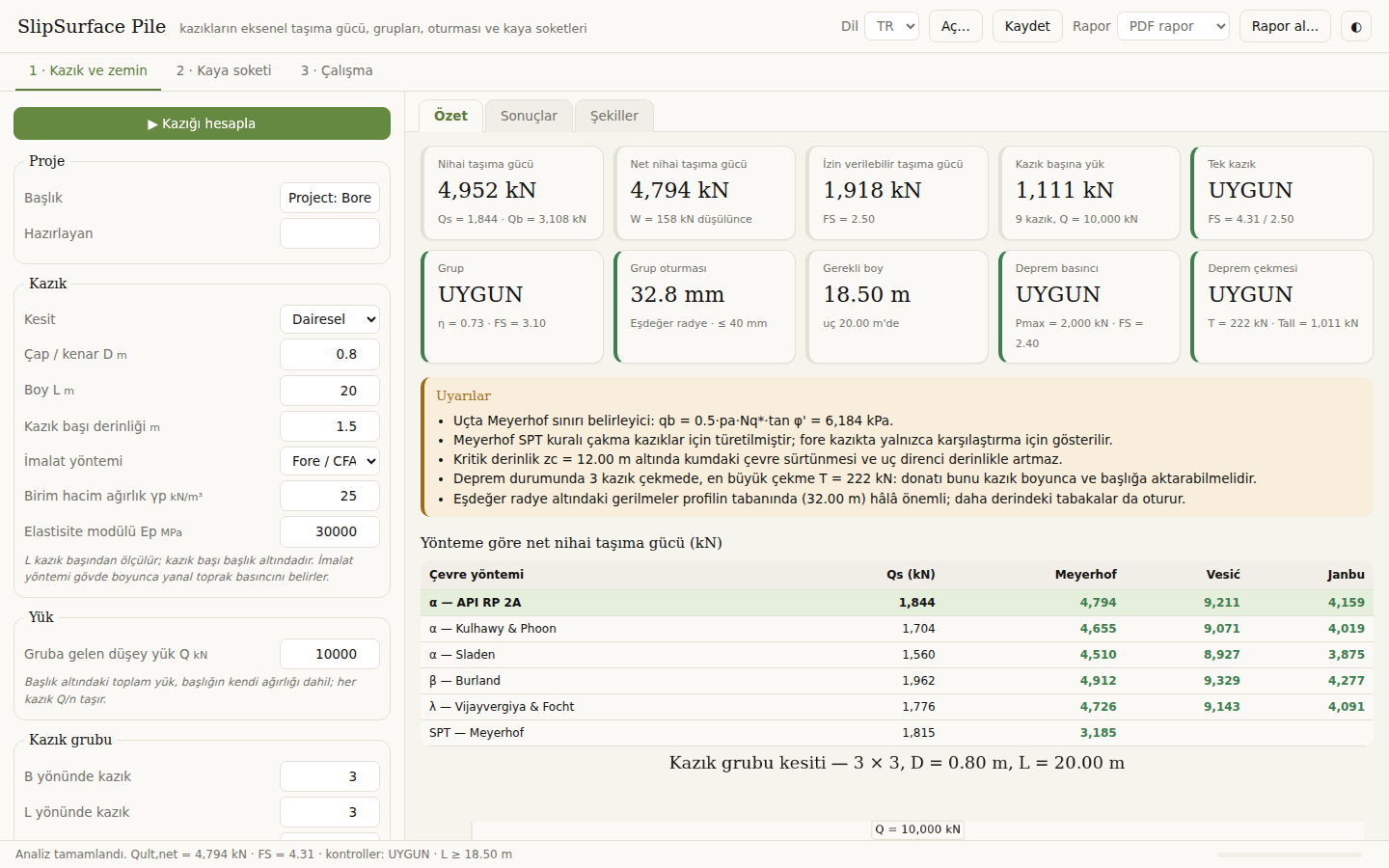
Shaft friction by the α, β and λ methods, Meyerhof/Vesić/Janbu base resistance, group efficiency and block failure, compression and uplift under seismic loading, required length, single and group settlement; rock sockets by twelve correlations.

  • α · β · λ methods
  • 4 group efficiencies + block
  • Seismic: compression and uplift
  • 12 rock socket correlations
$ slipsurface-pile

Retaining structures

Sheet pile walls, reinforced soil and cantilever concrete walls.

SlipSurface IQ SPWAv0.3.1

Sheet pile wall analysis

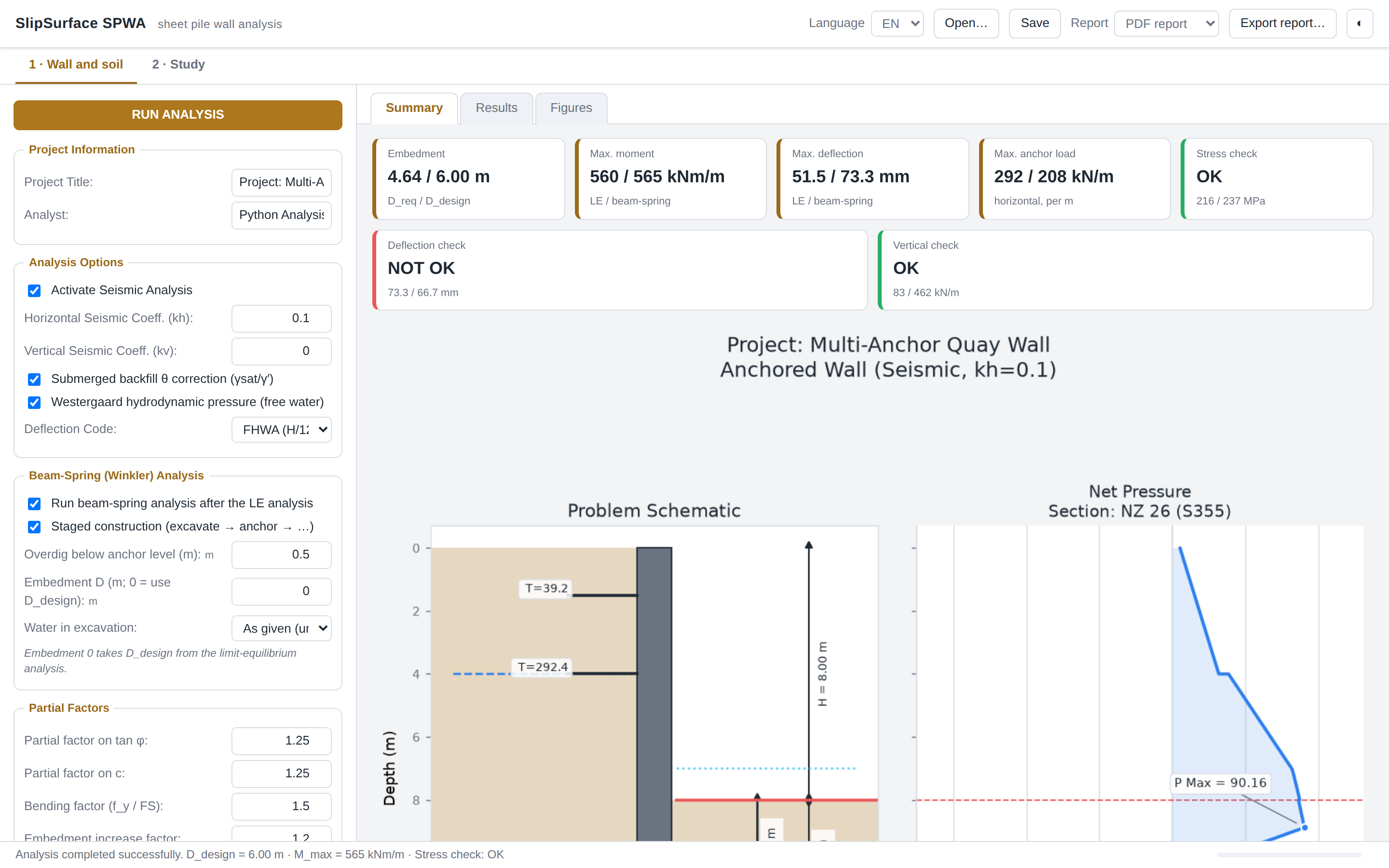
Free-earth support limit equilibrium and staged Winkler beam-spring analysis side by side; Mononobe-Okabe seismic pressures, tension-only anchors and reliability studies.

  • Free-earth support
  • Staged beam-spring (Winkler)
  • Mononobe-Okabe + Westergaard
  • Sheet pile section database
$ slipsurface-spwa

SlipSurface IQ MSEWv0.3.1

Mechanically stabilised earth walls

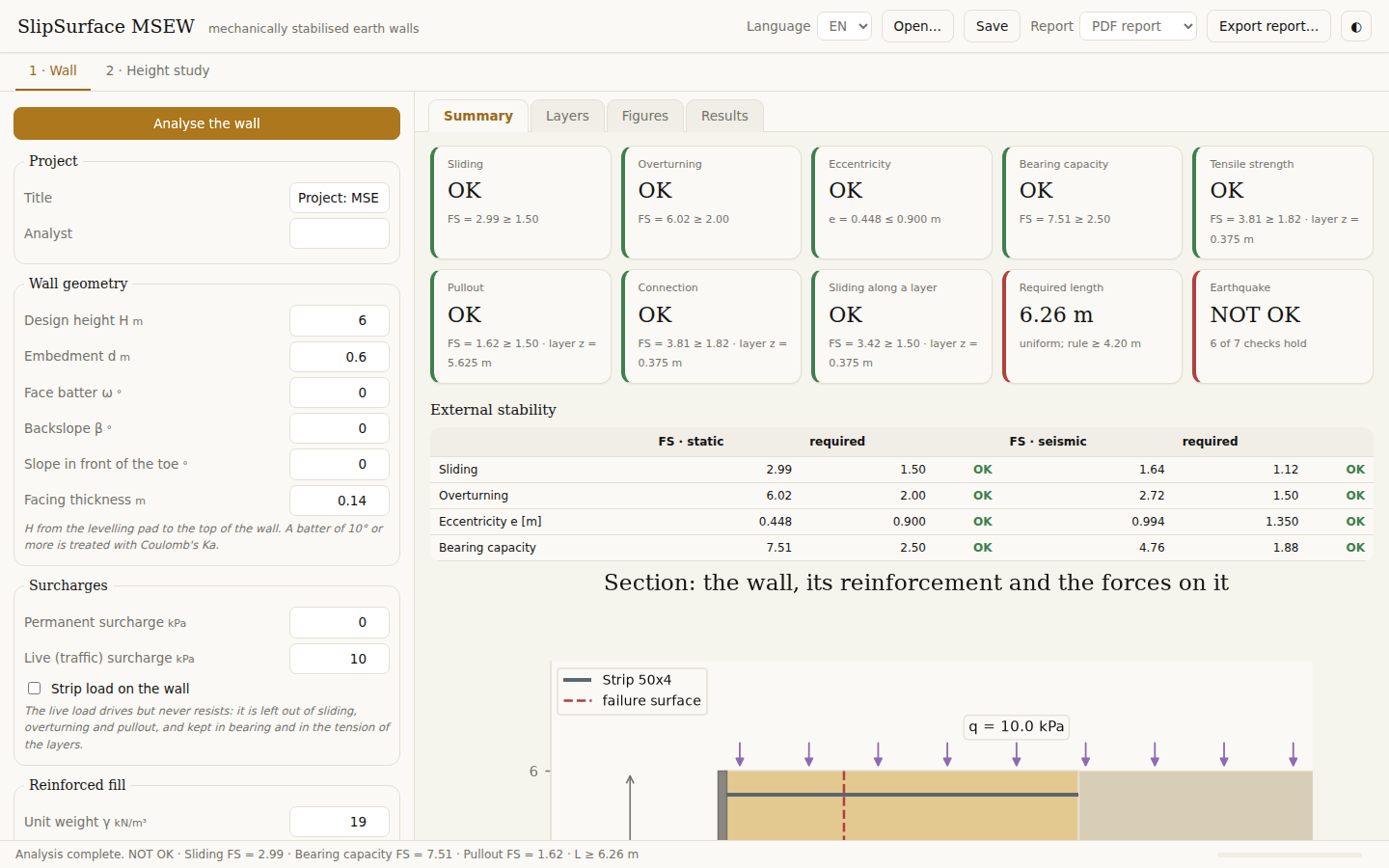
External and internal stability per FHWA-NHI-10-024 and AASHTO LRFD 11.10: sliding, overturning, bearing, tensile, pullout, connection; steel strips and geosynthetics, corrosion, earthquake, ASD or LRFD.

  • External + internal stability
  • Steel strips and geosynthetics
  • ASD or LRFD
  • Wall height study
$ slipsurface-msew

SlipSurface IQ Wallv0.3.1

Cantilever retaining wall design

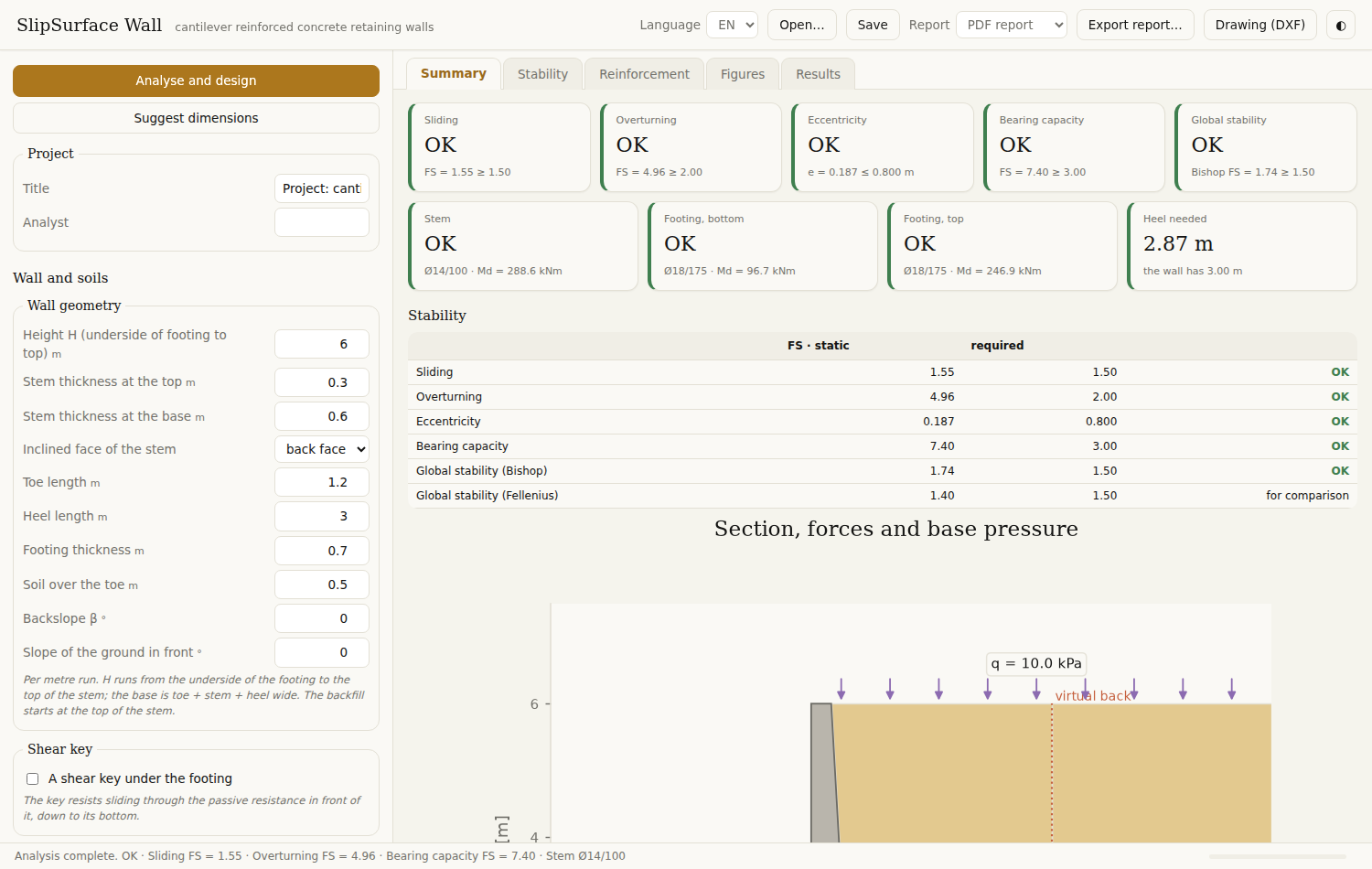
Earth pressure by four methods, sliding, overturning, bearing and global stability; earthquake by TBDY 2018; TS 500 reinforced concrete design, the reinforcement drawing, DXF and bar schedule.


  • Rankine · Coulomb · K0 · trial wedge
  • TBDY 2018 earthquake
  • TS 500 reinforcement design
  • Reinforcement drawing + DXF
$ slipsurface-wall

In development

New members of the family; they join the list above when they are released.

SlipSurface IQ Tunnel

Tunnel analysis

Analysis and design of tunnels and underground excavations.

In development

SlipSurface IQ Liquefaction

Liquefaction assessment

Assessing the liquefaction potential of soils during earthquakes.

In development

SlipSurface IQ Correlation

Soil parameter correlations

Estimating soil parameters from field and laboratory tests by published correlations.

In development

SlipSurface IQ 3D

3D geotechnical analysis

Three-dimensional analysis of geotechnical problems.

In development

One architecture, ten tools

Learn one and you know them all. Same interface layout, same files, same commands.

Driven from a browser

The interface is a small HTTP server on your own machine. It works over a remote session, in a container and on a headless server.

Bilingual

Every label, result, figure and report in English and Turkish; switch while it runs — the numbers never change.

One-source reports

PDF, self-contained HTML and Word reports come from one assembly, so all three say the same thing.

Project files

Inputs are saved as readable JSON. A case set up in the browser re-runs unattended from the command line.

Reliability studies

Sweep any input as a range or a distribution: LHS, Monte Carlo, sensitivities, probability of failure and β.

Validated

Every method is pinned with pytest against published tables, hand calculations and closed-form solutions.

Three ways in

One engine — click through it in the browser, drive it from the command line, or script it from Python.

The SlipSurface IQ Bearing interface: six methods side by side, the checks and the width required.

All of them, on one project

Follow the design of an excavation, a fill, a piled foundation and an anchored wall on a port site end to end, with the right SlipSurface IQ tool at every step.

Go to the end-to-end example →
  1. 1SlipSurface IQ Bearing
  2. 2SlipSurface IQ Settle
  3. 3SlipSurface IQ Pile
  4. 4SlipSurface IQ SPWA
  5. 5SlipSurface IQ LE
  6. 6SlipSurface IQ 2D

Your first analysis is five minutes away.

Python 3.10+ and a single pip command.

Installation guide →

SlipSurface IQ is an independent open-source project for geotechnical and rock engineering, developed by Hasan Deniz Altuntaş.
Released under the AGPL-3.0 licence.